

About Course

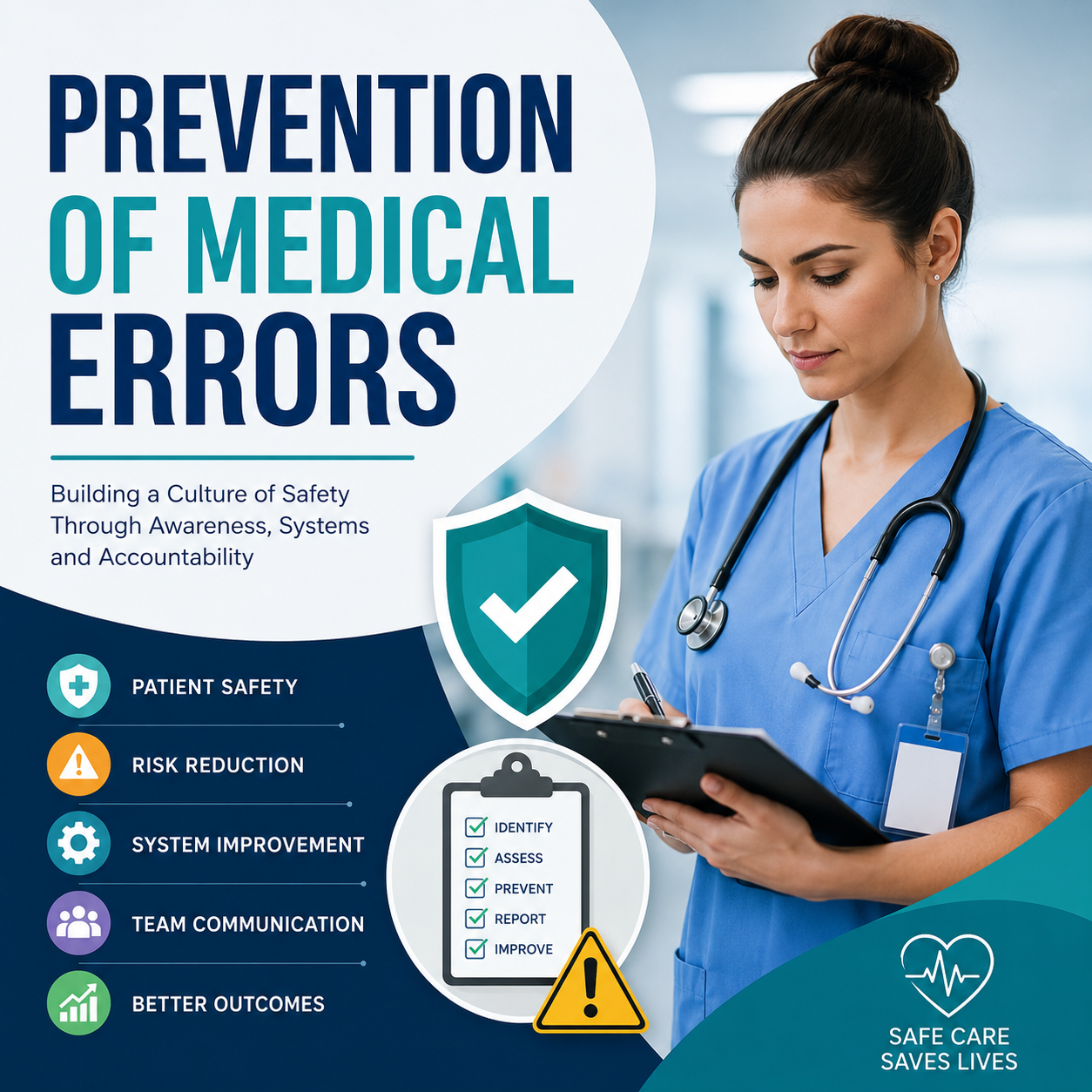
This course provides an evidence-based review of medical errors in healthcare, including types, causes, prevention strategies, and reporting requirements. Emphasis is placed on systems-based practice, patient safety, and the nurse’s role in reducing errors and improving healthcare outcomes. 

What you'll learn

  • Upon completion of this course, the learner will be able to:
  • Define medical errors and distinguish between active and latent system failures.
  • Explain the principles of systems theory and their application to patient safety improvement.
  • Identify common human factors and cognitive biases that contribute to medical errors in healthcare settings.
  • Discuss the impact of fatigue, workload, interruptions, and environmental conditions on clinical performance and patient safety.
  • Describe the Swiss Cheese Model and its relevance to healthcare error prevention.
  • Apply principles of Root Cause Analysis (RCA) to evaluate adverse events and identify contributing system factors.
  • Explain the purpose and process of Failure Mode and Effects Analysis (FMEA) in proactive risk reduction.
  • Identify characteristics of high-reliability organizations and their role in promoting patient safety.
  • Discuss the importance of just culture, interdisciplinary communication, and non-punitive error reporting systems.
  • Implement evidence-based strategies that reduce preventable harm and strengthen safety culture in clinical practice.

Course Content

Prevention of Medical Errors

  • Course Completion Requirements
  • Course Overview
  • Learning Modules
  • POST TEST
  • Course Evaluation and Learner Attestation
  • Certificate of Completion